Hello reader!
I am no longer blogging at this site but have moved to http://greenghanaian.wordpress.com where I cover challenges of environmental preservation in Ghana. I am also no longer a student at University of Maryland. I have graduated and am currently working as a consultant for environment and climate change in Accra, Ghana, West Africa. Feel free to browse through the site and read any of my older posts... and come visit me at my new blog!
Thanks!
Monday, May 28, 2012

Sunday, December 26, 2010
New Year: New Look: New Focus
This blog, which began as a class project, has changed my life. I am very appreciative of the readers and comments (on and offline). Since the end of May I have not posted anything new due to the heavy load of work and school I have had in the past months but I have decided to continue with it as I begin the new year.
As a class project, the focus was on bringing technological news in Ghana (and Africa) to the outsider so they could witness progress and unique tech applications on the continent. There were guidelines and requirements that I had to stick to in order to pass the class (I got a B). Well, thank heavens the class is over. I will now be able to add my own flavor to the blog and the posts will tend to be more opinionated. I welcome comments and discussion... and refer others to read as well!!!
Happy Holidays and Happy New Year!
Afehyia pa!!
As a class project, the focus was on bringing technological news in Ghana (and Africa) to the outsider so they could witness progress and unique tech applications on the continent. There were guidelines and requirements that I had to stick to in order to pass the class (I got a B). Well, thank heavens the class is over. I will now be able to add my own flavor to the blog and the posts will tend to be more opinionated. I welcome comments and discussion... and refer others to read as well!!!
Happy Holidays and Happy New Year!
Afehyia pa!!
Saturday, May 8, 2010
Drawing the Semester to a Close: Reflections
This class has been a very good learning experience. I am very glad that I took it. I have learned so much about trending technologies, how technology is changing the face of journalism and how the rate of adoption of new technology is reshaping everything from education to health to politics to fashion.
My favorite post would have to be the two posts regarding the use of Facebook by Africans and by Ghanaians. I think I loved this post the most because it was a compilation of research that I did myself. The statistics that I presented referring specifically to Ghana were gathered by my friend and me through a survey that I created. It confirmed one of the most important points presented throughout my blog. Mobile technology has penetrated Africa beyond grid electricity and land-line internet.
My least favorite post was that on the use of cell phones in the US which was a homework assignment for class. This is probably because the articles we had to read in order to respond to the topic involved a lot of data that was hard for me to synthesize.
I am ending with e-waste because I feel this is a topic that was not touched on in class. As an environmental science and technology major that grew up in Africa, this is a huge concern for me. A lot of emphasis in this class has been placed on what’s new and upcoming but no one has considered the effects of so much technology and hardware being produced. The only way to keep adopting new technology is to trash old ones, hence the big e-waste problem. Its killing the environment and causing poisoning to a lot of women and children in the developing world.
Overall, this has been an awesome experience. I do believe I will be blogging in the future.
Recycling while bridging the global digital divide

In my previous post, I talked about electronic waste (e-waste) and how many developed countries are creating a new type of pollution in developing countries. This happens when old computers and other electronics are discarded or recycled but end up being shipped to landfills in developing countries instead of being handled in the regulated manner because it costs less to do so. Well, in this next story, we see how a company is making a difference in this trend.
Collecting and Recycling Ecologically (CARE): Computers for Developing Countries is a company based in the United Kingdom and operating in Ghana that takes redundant computers that British companies wish to discard and recycles them by donating them to schools and colleges in Ghana. This might sound like not such a big deal but here is where it makes a real difference. In the previous posting, the video showed how many of these discarded computers come as ‘donations’ and 50% of them don’t even work. This is what creates the waste because no one is going to repair these outdated computers so they get thrown away. And then the pollution gets out of hand when there is such an abundance of these that they are burned for their copper wire by scavengers and children releasing toxic fumes.
CARE removes this danger by assessing every computer that goes through their system. Computers and computer equipment is collected from businesses, schools and individuals for a small fee. All data on the equipment is then wiped clean to Ministry of Defense standards. It is after this that the computers are shipped to Ghana for distribution. They are taken to service centers that are responsible to installing new programs as well as training IT specialists to maintain the PC systems once installation is complete at the schools. After the donations, the students and teachers are also trained to use and maintain computers. Their program enables schools in Ghana and the UK learn from each other as they collaborate through the internet. They are working towards projects that will forge international projects and relationships.
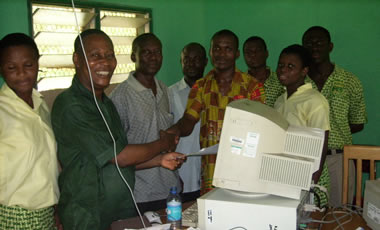
But there is yet another component of this company that does even more to combat pollution in Ghana. There is an increasing plastic waste problem that exists in the country. Almost everything that is sold in Ghana is vended in plastic bags, including water. Water is sold on city streets in plastic packets instead of bottles. These plastic packets and black plastic bags used to hold everything have been accumulating on trash dumps and on the streets since they aren’t biodegradable. Currently, there is no national waste management system in the country. The bags also clog the drainage systems causing floods during the heavy rain season. For this reason, an ‘Eco-Code’ has been drafted by CARE to be signed by all students of schools that receive computers donations. This code requires them to put measures in place to curb this pollution.
I look forward to seeing how CARE will change the face of pollution and recycling in Africa and the e-waste menace.
Tuesday, April 27, 2010
Digital Dumping: the latest environmental crime
Ever wondered what happened to your old televisions, radios, computer monitors and systems when you threw them away and upgraded? I’m sure some of you might have donated them to charity, others might have ‘recycled’ them with electronic companies, and then some of you just threw them in the dumpster (admit it). Well, I have news for you. They all end up in the same place regardless of how you got rid of it.
It is becoming big business to ship outmoded electrical overseas to poorer countries instead of recycling them with environmentally safe methods. Some of these countries have no idea that they are getting ‘trash.’ They are told that they are ‘donations’ only to find out that half of them don’t even work. The non-functional goods are then dumped on sites that have turned into mountains. This sort of pollution would never be entertained in America. But America is causing it elsewhere. And as these heaps of e-waste grow, the poor begin to scavenge through the rubble is search of anything valuable. Boys and women, even children have created an occupation out of searching through e-waste trash heaps for valuable copper wire and other spare parts that could be sold for money. In order to be able to extract these wires and parts, they burn the plastics coverings of the monitors and tvs to expedite the process. The fumes emitted are toxic and are a slow poisoning to these ignorant victims of the irresponsibility shown by the developed world.
The video below, presented by Frontline on PBS, gives detailed coverage of the process, first visiting the Korle Lagoon in Ghana and then tracking a container of supposedly recycled e-waste all the way to Hong Kong. The Korle Lagoon was once a wetland that helped maintain the natural balance of the environment in and around Ghana’s capital, Accra. Now it has been named one of the most polluted water bodies in the world. Even the locals call it Sodom and Gomorrah: a dumping site for the trash that the West has conveniently forgotten about.
The fight against the dumping of e-waste is a global campaign that is finally beginning to attract the attention of the necessary decision-makers of developed countries. With all the conversation around the world about climate change and environmental preservation, hazards like this are no longer able to fly under the radar. I will bring more developments on the steps that NGO’s and governments are taking to clean up the mess that has been made.
It is becoming big business to ship outmoded electrical overseas to poorer countries instead of recycling them with environmentally safe methods. Some of these countries have no idea that they are getting ‘trash.’ They are told that they are ‘donations’ only to find out that half of them don’t even work. The non-functional goods are then dumped on sites that have turned into mountains. This sort of pollution would never be entertained in America. But America is causing it elsewhere. And as these heaps of e-waste grow, the poor begin to scavenge through the rubble is search of anything valuable. Boys and women, even children have created an occupation out of searching through e-waste trash heaps for valuable copper wire and other spare parts that could be sold for money. In order to be able to extract these wires and parts, they burn the plastics coverings of the monitors and tvs to expedite the process. The fumes emitted are toxic and are a slow poisoning to these ignorant victims of the irresponsibility shown by the developed world.
The video below, presented by Frontline on PBS, gives detailed coverage of the process, first visiting the Korle Lagoon in Ghana and then tracking a container of supposedly recycled e-waste all the way to Hong Kong. The Korle Lagoon was once a wetland that helped maintain the natural balance of the environment in and around Ghana’s capital, Accra. Now it has been named one of the most polluted water bodies in the world. Even the locals call it Sodom and Gomorrah: a dumping site for the trash that the West has conveniently forgotten about.
The fight against the dumping of e-waste is a global campaign that is finally beginning to attract the attention of the necessary decision-makers of developed countries. With all the conversation around the world about climate change and environmental preservation, hazards like this are no longer able to fly under the radar. I will bring more developments on the steps that NGO’s and governments are taking to clean up the mess that has been made.
E-WASTE: Re-Focusing of my blog
For the remainder of the semester we have been asked to refocus our blogs on one particular topic. Something that we believe has not been covered in class or something we would like to talk about that has to do with technology. I have decided that I will focus the remainder of my blogging on E-waste. This is a term given to the remains of electronics such as old televisions, radios and computers. At the moment, there exists no legislation in the United States to regulate how these items are discarded of. The EPA has made rules of its own that keep the US in check. But what about the rest of the world? I will focus my upcoming posts uncovering the situation not really here in the US but worldwide.


Monday, April 26, 2010
Photography in Ghana: rising to great heights
There are two Ghanaian photographers in Ghana that are breaking grounds in photography. They are Sefa Nkansah and Emmanuel Bobbie who goes by the name ‘Bob Pixel.’ These men have given a new twist to African photography and have a following that increases daily. It’s awesome to see the perspectives they put on life and watching their slideshows has become a habit of mine.
Here, a familiar image is given a new look. It’s common to see African women with babies strapped on their backs. But not all of them ride bicycles.
 That right there is a woman on the move. She had a place to go and was determined to get there. I’m sure the baby enjoyed the ride too. She could have been on the bike all day running errands and decided to take a rest. Here, the photographer got his chance to capture the moment.
As kids, boys made toy cars with tin cans, rubber bands, twigs and other things. And sometimes, it was just a car tire and two sticks. Those were always the easiest and you could run fast with them.
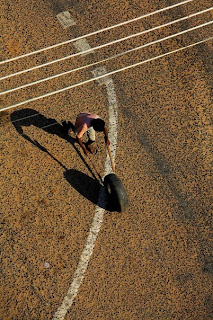 Sefa Nkansah’s capture of this simple toy from a rooftop just blows my mind. Anyone who saw this picture commented that they would have never thought to take this from a rooftop. The color and the street and the shadow just makes you want to get a tire yourself and start running. It’s pretty brilliant.
But the most brilliant picture, in my opinion, happens to be this one here.
 I’m the type of person that can sleep practically anywhere but I don’t think I’d manage this. He seems so comfortable taking his nap after a hard day’s work. The picture communicates so much. The lighting (or lack thereof), the position, the clarity and then the fact that it’s in black and white gives it a real professional touch. One of Bob Pixel’s best.
Good job guys on all of these photos.
And to add a footnote: these men are friends. They would, in normal circumstances, be rivals competing against each other but they rather comment and criticize each other's work positively and that is commendable of both of them.
Here, a familiar image is given a new look. It’s common to see African women with babies strapped on their backs. But not all of them ride bicycles.

As kids, boys made toy cars with tin cans, rubber bands, twigs and other things. And sometimes, it was just a car tire and two sticks. Those were always the easiest and you could run fast with them.
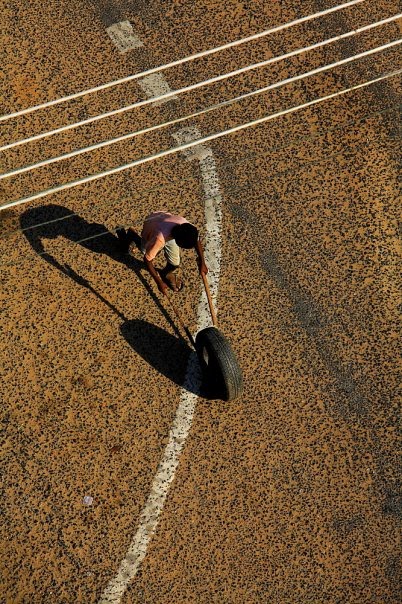
But the most brilliant picture, in my opinion, happens to be this one here.

Good job guys on all of these photos.
And to add a footnote: these men are friends. They would, in normal circumstances, be rivals competing against each other but they rather comment and criticize each other's work positively and that is commendable of both of them.
The Fastest Cell Phone Rumor
A week or so after the catastrophic earthquake in Haiti, a rumor spread in Ghana that there would be an earthquake. No one has been able to trace the source of the rumor but what was confirmed was the speed at which the rumor spread. Within one day, primarily via text message and sometimes phone calls, this rumor was able to spread throughout the entire country and many did not sleep that night. In fact, many spent the night in open fields and parks waiting for the tremor that never came.
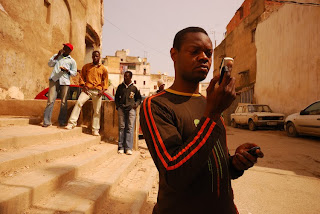 This is the picture that came along with the story. The picture does not tell the story as much as one with a group of people sitting on a field in the middle of the night would have. It could have been taken from anywhere and used for this story. The unique use of technology to play a national hoax is impressive though. I laughed when I first heard the story from a friend and almost didn’t believe it. He also mentioned that the reality of the situation did not dawn people as quickly and some were going about their day wondering when the earthquake would come. Meteorologists did eventually confirm that there was indeed no earthquake to come and calm has since been restored.

A different perspective
I have indeed enjoyed blogging about technology in Ghana this semester. I believe that I have been able to provide a different perspective on technological developments and news in Ghana as well as the unique applications of certain technologies in Ghana like the phone booth, cell phones as well as facebook. But as they say, a picture is worth a thousand words. And there are some pictures that I have found that do just that.
This first picture is one that says it all.
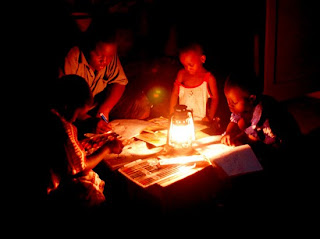
In Ghana, there are so many that go without electricity and this is how some kids do their homework at night, by the use of kerosene lamps. In America we take electricity for granted but in Ghana, there are many people that are forced to end their day when the sun sets. And this isn’t just a problem in villages. If you aren’t rich enough to buy a generator when there is a sudden power outage even in the city, you would still be powerless. Kerosene lamps are the solution to most lighting needs like night time homework and the first thing that comes to mind is the fire hazard that exists with this scenario. If this lamp tips, all homework would be on fire - and many other things as well.
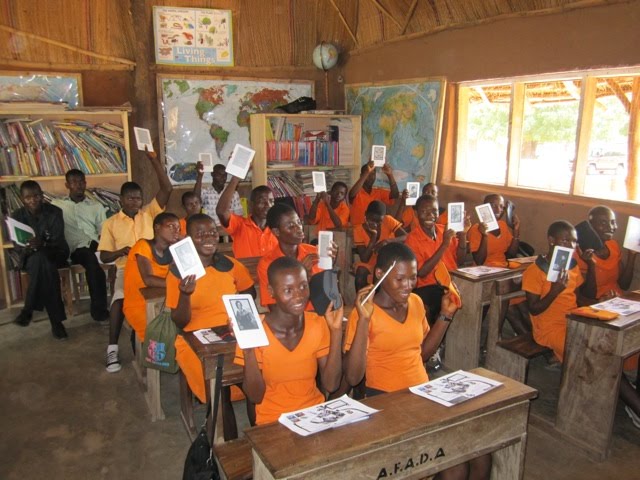
Another topic that has been on the tech headlines this past month or so is the emergence of the Ipad. There’s been all this craze here in the West about how innovative it is and all its capabilities but in villages that are running on solar power (if any at all) and satellite internet (if any at all), the kindle remains the favorite. There are so many barriers in education that the kindle can solve. A lack of books in schools would not longer exist because they could just be downloaded. Students could read in the night when there is no electricity and they would also have enhanced their technological adaptability. It also doesn’t have the bulkiness of a desktop computer or even a laptop. This underappreciated instrument has made life easier for those in less developed areas and will continue to do more. That can be seen on the faces of these students in this picture.
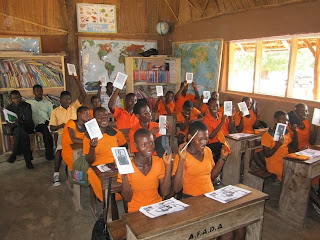 The photographic quality is not the best but the rule of thirds was obeyed and the impact that these kindles will have on the lives of these children who I’m sure have suffered conditions similar to what is shown in the first picture will be eternally grateful. It lasts for 2 weeks without a charge and has free internet access. This is a clear demonstration of how Africa takes technologies here and makes them their own.
This first picture is one that says it all.
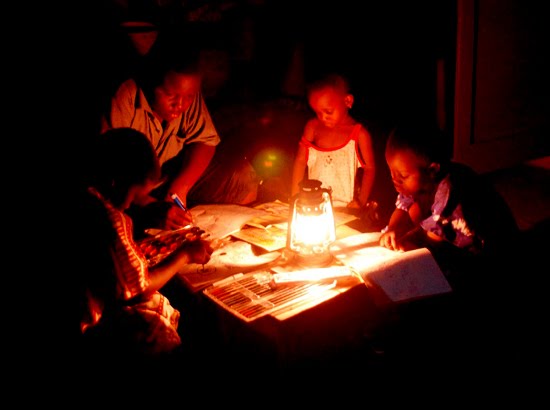
In Ghana, there are so many that go without electricity and this is how some kids do their homework at night, by the use of kerosene lamps. In America we take electricity for granted but in Ghana, there are many people that are forced to end their day when the sun sets. And this isn’t just a problem in villages. If you aren’t rich enough to buy a generator when there is a sudden power outage even in the city, you would still be powerless. Kerosene lamps are the solution to most lighting needs like night time homework and the first thing that comes to mind is the fire hazard that exists with this scenario. If this lamp tips, all homework would be on fire - and many other things as well.
Another topic that has been on the tech headlines this past month or so is the emergence of the Ipad. There’s been all this craze here in the West about how innovative it is and all its capabilities but in villages that are running on solar power (if any at all) and satellite internet (if any at all), the kindle remains the favorite. There are so many barriers in education that the kindle can solve. A lack of books in schools would not longer exist because they could just be downloaded. Students could read in the night when there is no electricity and they would also have enhanced their technological adaptability. It also doesn’t have the bulkiness of a desktop computer or even a laptop. This underappreciated instrument has made life easier for those in less developed areas and will continue to do more. That can be seen on the faces of these students in this picture.
Monday, April 19, 2010
My Ideal Video Game
This is to answer a class assignment asking what our ideal video game would be in relation to our blog topics. These are my thoughts:
An ideal game covering my topic would be a game for African youth in Africa. I thought of the idea of an African game for American children but the idea didn’t hold as much water to me. The reason for this is that my blog topic seeks to demonstrate how technology is developing and growing in Africa and its unique applications. And so, my game would seek to get the minds of the younger children on the continent to think in more technological ways that are directly beneficial to themselves and their environment.
In my game, there would be a problem in the village or town to solve. This could be, for example, a way to transport water from the main village center to individual homes or an attack from an unnamed people (or species). The object of the game would be to utilize local things within the village to create the solution to the problem. This could be, in the instance of the water transportation scenario, a piping system or in the case of the foreign attack, some sort of weapon. In all instances, the goals of the game would be technology-oriented and require creative and critical thinking.
The gamer would continuously be rewarded by the accuracy of the parts they choose for the technical ‘problem-solving machine’ and the speed at which they are able to identify and assemble them. There would also be visual improvements to the game environment as the player approaches a feasible end that would benefit the whole village and possibly win them a monetary prize or title. Reward could also be given for the most environmentally conservative applications/steps.
I think this would work well for African kids because they love to be seen as clever and they love titles and prizes. I believe all kids do.
An ideal game covering my topic would be a game for African youth in Africa. I thought of the idea of an African game for American children but the idea didn’t hold as much water to me. The reason for this is that my blog topic seeks to demonstrate how technology is developing and growing in Africa and its unique applications. And so, my game would seek to get the minds of the younger children on the continent to think in more technological ways that are directly beneficial to themselves and their environment.
In my game, there would be a problem in the village or town to solve. This could be, for example, a way to transport water from the main village center to individual homes or an attack from an unnamed people (or species). The object of the game would be to utilize local things within the village to create the solution to the problem. This could be, in the instance of the water transportation scenario, a piping system or in the case of the foreign attack, some sort of weapon. In all instances, the goals of the game would be technology-oriented and require creative and critical thinking.
The gamer would continuously be rewarded by the accuracy of the parts they choose for the technical ‘problem-solving machine’ and the speed at which they are able to identify and assemble them. There would also be visual improvements to the game environment as the player approaches a feasible end that would benefit the whole village and possibly win them a monetary prize or title. Reward could also be given for the most environmentally conservative applications/steps.
I think this would work well for African kids because they love to be seen as clever and they love titles and prizes. I believe all kids do.
Monday, April 5, 2010
My Infancy in Photography
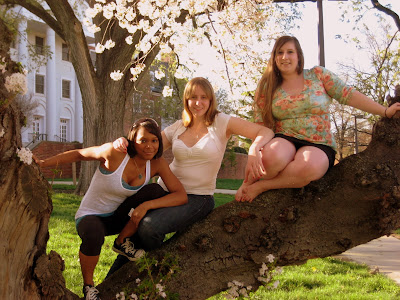
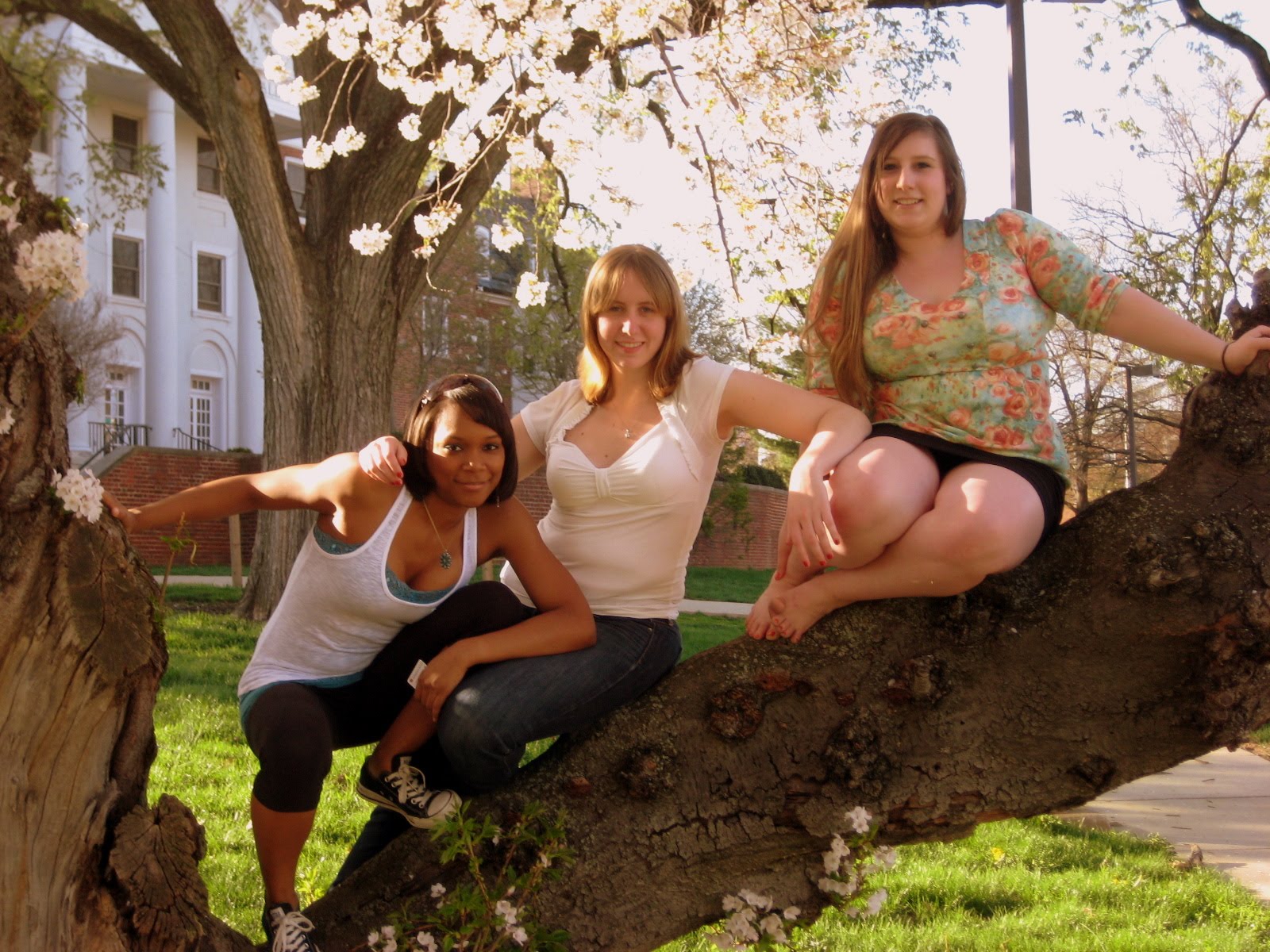
I really do consider myself to be an infant when it comes to photography but I am learning. Here are my first shots. The first I am very proud of. I call it 'Cherry Blossoms Before Easter'. It was taken the Thursday before Easter and it was a beautiful day. My friends sat in a tree and posed for me. This was my best shot.
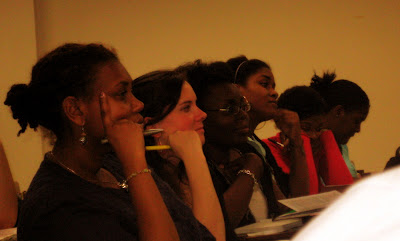
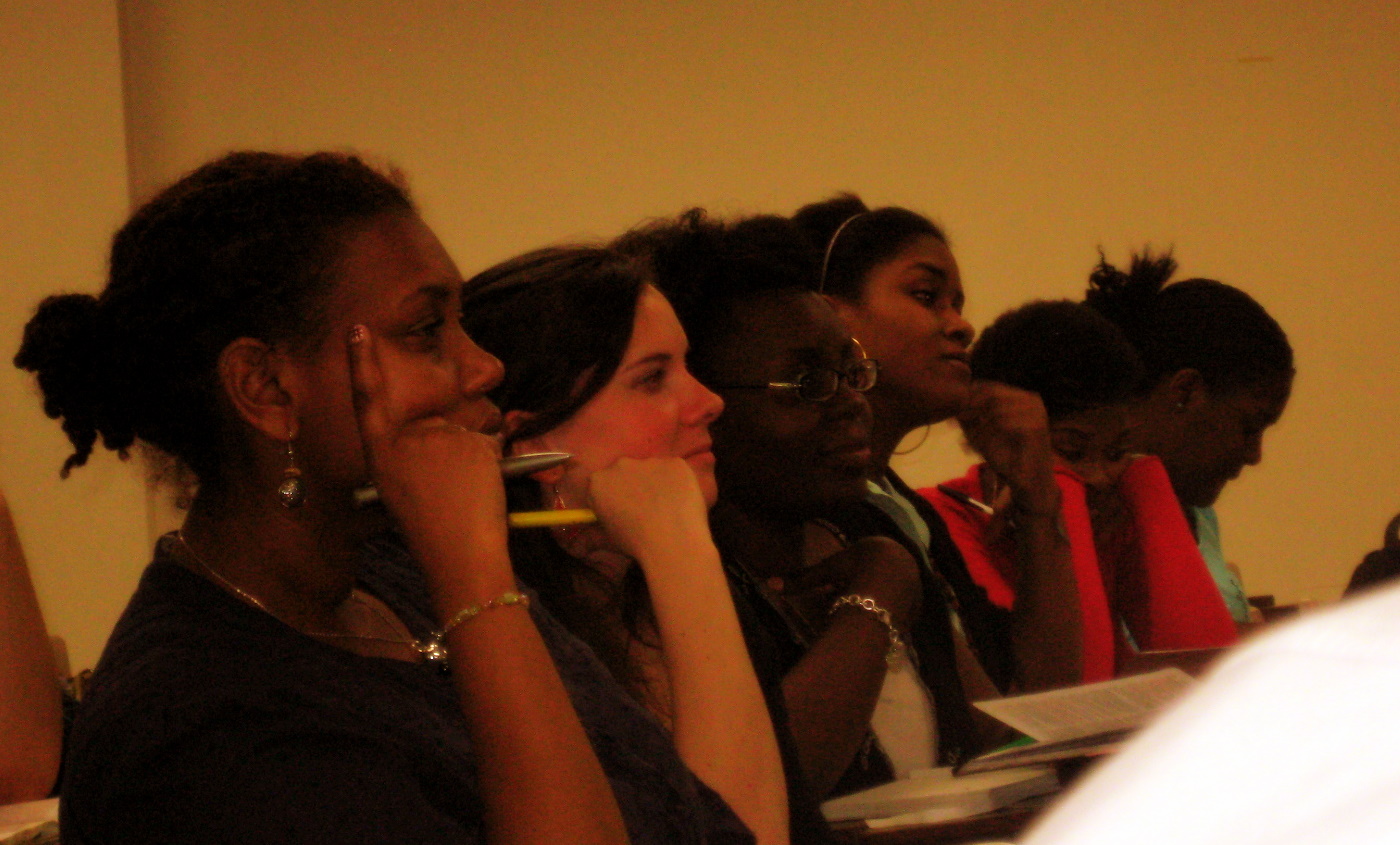
The second I know could have been better but it was taken during an event and I was siting in my seat. I couldn't get a better angle or focus. I saw the moment of concentration on the lesson that being given and decided to capture that. I call it 'Concentration in Shades.'
They both were edited using Picasa but the first didn't need much editing. 'I'm feeling lucky' was enough to make this picture almost perfect. The second one however needed a little more tweaking. I used the sharpen tool as well as the warmity and fill light. I also had to crop it. I think I will have better shots coming up. We will see!!!
The second I know could have been better but it was taken during an event and I was siting in my seat. I couldn't get a better angle or focus. I saw the moment of concentration on the lesson that being given and decided to capture that. I call it 'Concentration in Shades.'
They both were edited using Picasa but the first didn't need much editing. 'I'm feeling lucky' was enough to make this picture almost perfect. The second one however needed a little more tweaking. I used the sharpen tool as well as the warmity and fill light. I also had to crop it. I think I will have better shots coming up. We will see!!!
Sunday, April 4, 2010
The Story Behind the Picture
This week our class is taking a focus on photojournalism. This is a very new concept to me as I’m not a journalism major and I never really took too much time to think about how much work goes into conveying a message through pictures and video. So far we have learned a lot about how to make a picture tell a great story and how some pictures don’t do so well. With this in mind I am giving my own evaluation of some pictures I have found that do a great (and not so great) job of conveying my focus which is Technology in Africa (Ghana).
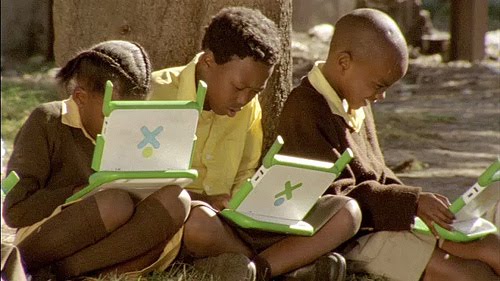
The first picture below is one that I fell in love with immediately:
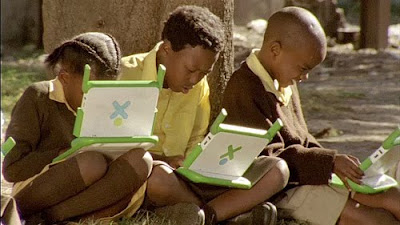 It doesn’t have the best focus and the lighting is not the best but the centering of the children follows the rule of thirds and it tells a real story to me. I can see the excitement and enthusiasm of the children with their laptops. Their eyes are so glued on the screen they don’t even realize someone is taking a picture of them. It made me remember what it was like to be a kid and so engrossed with a computer or a game that I couldn’t even hear someone calling my name. Kudos to the photographer here.
Next is this picture:
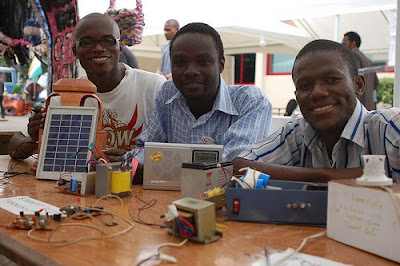 This picture is one I also like a lot. One can see the rule of thirds coming out in the shot as well as the main items in the scene telling the story. Apparently these gentlemen are working on a technology incorporating a small solar panel. They seem very excited to be where they are and seem to have been quite busy with their gadgeting.
Here is one that doesn’t do a good job at all.
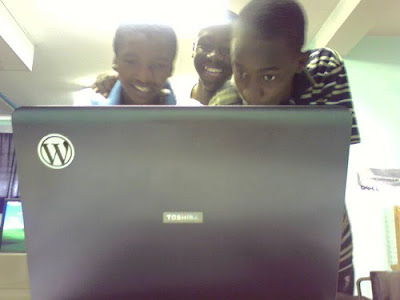 It looks like this picture was taken from a cell phone so you can only expect a certain quality but I believe the photographer could have done a better job with what was available to him. First of all, the bright light in the room makes the laptop and even the children’s faces very hard to distinguish. A simple shift in his angle could have rectified that. Shifting his angle also could have enabled him to show a better perspective and tell more of the story in the picture. Perhaps raising the camera to get a fuller image of the kids and little of the background would have made a huge difference.
Here is another that could have been ten times better with just a shift in angle.
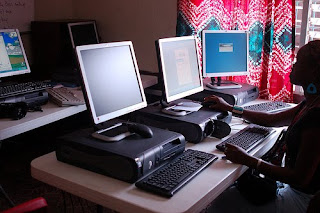 The picture is actually very focused (at least to me) but the lighting is so horrible its hard to tell exactly what the photographer wants to show. Shifting a little to the right and maybe upward would have given a better reflection of all three computer screens, given the lady a better spot in the picture as well as obeyed the rule of thirds quite well. This is poor photography from all angles.
Here again is one that I feel was just someone at the right place at the right time.

This photo shows just how valuable cars indeed can be to the livelihood of a people. Many westerners would have discarded this vehicle long ago but this photographer captures how one man’s trash can be another’s treasure. The load is heavy and impossible to transport. It doesn’t look like the car can hold it but that’s not stopping these merchants in Mauritania. They continue to load and strap even with the car’s flat tires. This photographer really captured that moment.
I will be looking at pictures totally different these days, and also taking them differently. Next I will post my own pictures taken with my digital camera and edited with Picasa. Then you can be the judge of the quality.
The first picture below is one that I fell in love with immediately:
Next is this picture:

Here is one that doesn’t do a good job at all.
Here is another that could have been ten times better with just a shift in angle.
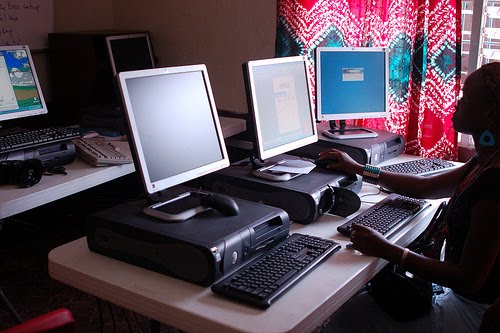
Here again is one that I feel was just someone at the right place at the right time.

This photo shows just how valuable cars indeed can be to the livelihood of a people. Many westerners would have discarded this vehicle long ago but this photographer captures how one man’s trash can be another’s treasure. The load is heavy and impossible to transport. It doesn’t look like the car can hold it but that’s not stopping these merchants in Mauritania. They continue to load and strap even with the car’s flat tires. This photographer really captured that moment.
I will be looking at pictures totally different these days, and also taking them differently. Next I will post my own pictures taken with my digital camera and edited with Picasa. Then you can be the judge of the quality.
Thursday, March 25, 2010
How Do Ghanaians Do It?

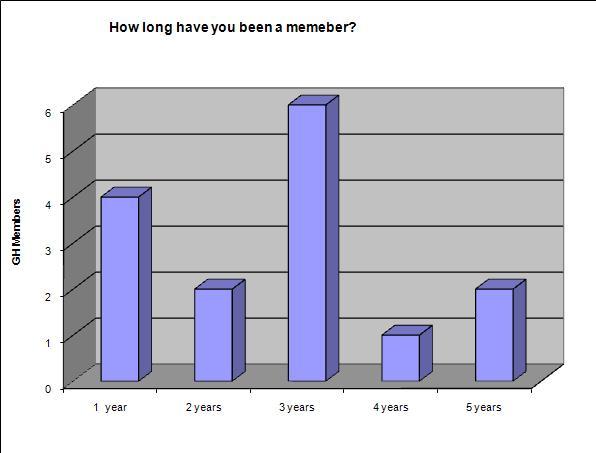
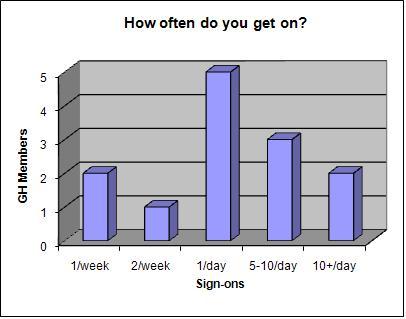

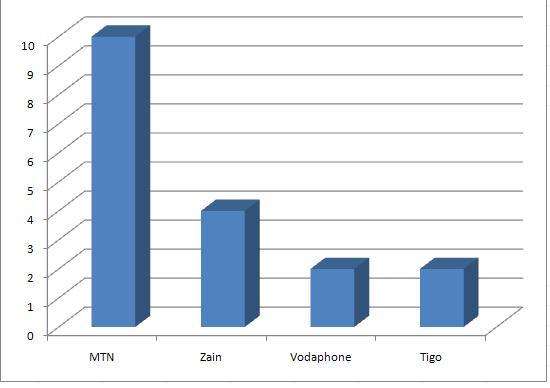


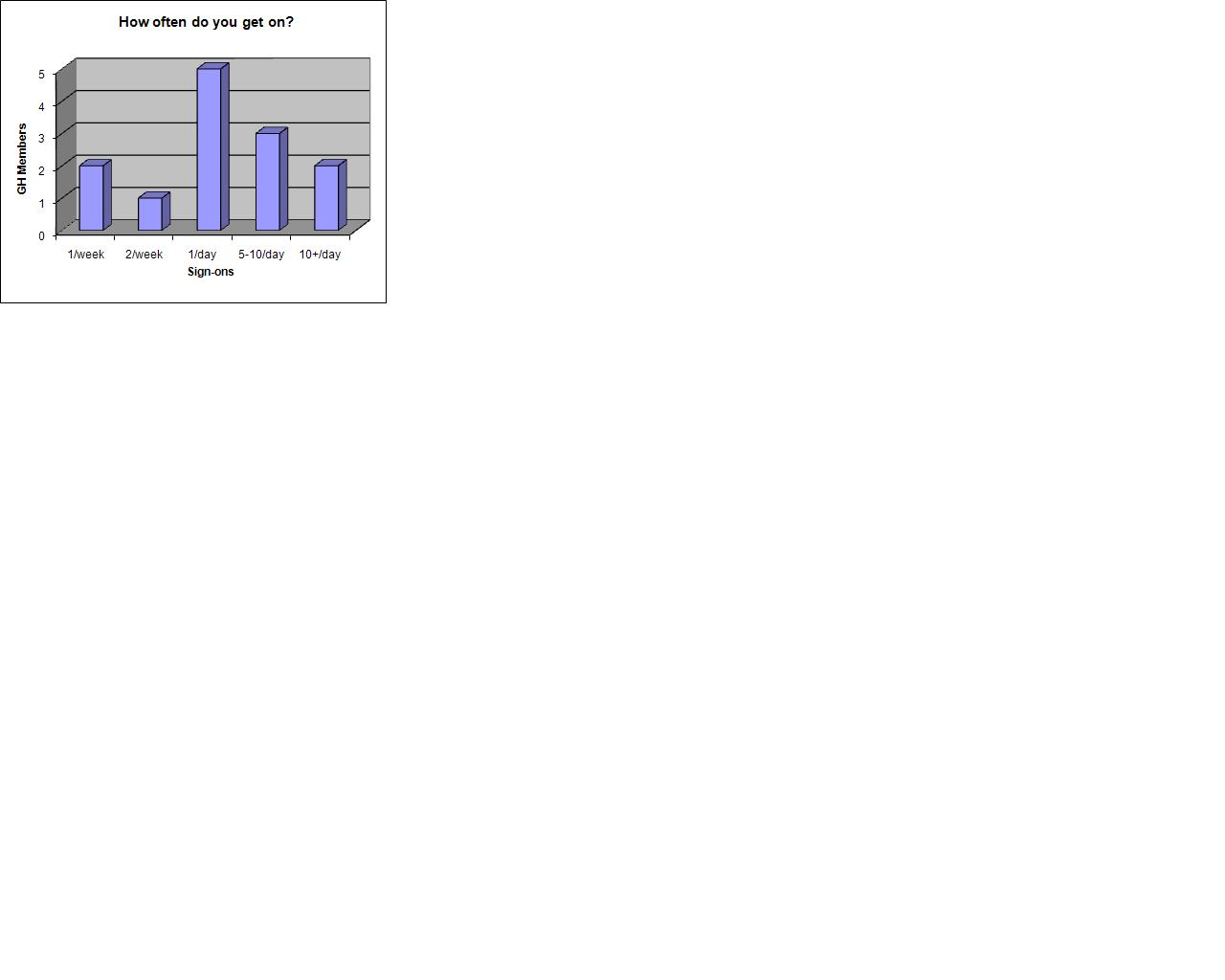
As you'll see from above, the numbers prove true about mobile phone use and the amount of time spent online. Mobile phone usage widely dominates the access with MTN being the largest mobile service provider. It was also shown that most of the users have been in use for three years or less. When asked, many prefer to use facebook to communicate with friends than even phone calls or email because its cheaper on their phones. A journalist uses it to spread information about his website and get readers for his articles. Many use it as the avenue to contact people outside the country instead of making international calls. Some gave stories of how they met friends that hadn't seen in over 10 years, some got jobs and contracts through facebook. One person even stated that they met their fiance on facebook.
Most said that they had been a member of Hi5, a social networking website that preceded facebook but they now are inactive even though they still have their accounts. Some dont even remember their passwords. They attributed facebook's takeover to it being user-friendly and the ability to chat. Other social networks used by participants include Twitter, Tagg, Myspace, LinkedIn and Badoo.
Wednesday, March 24, 2010
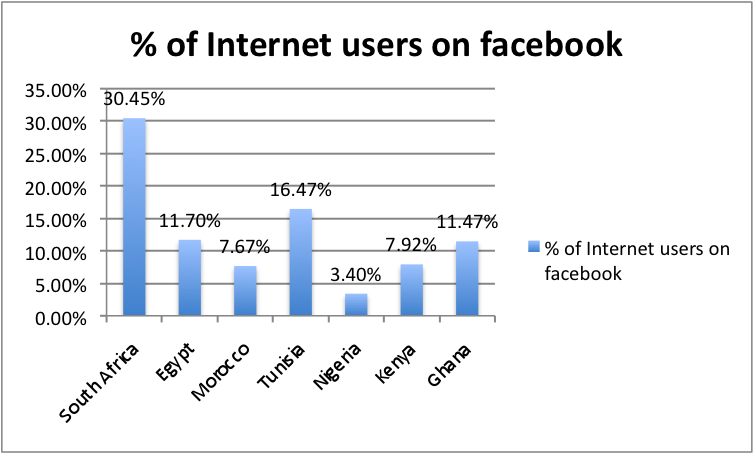
The Stats on Facebook in Africa

A report on Appfrica.net mentions countries like South Africa with 1.1 million users, Egypt with 900.000 users and Nigeria with 220,000 users. Ismail Dhorat on his StartupAfrica site gives better figures on the penetration of facebook compared to the penetration of the internet.

Tuesday, March 23, 2010
Africa Fights Fake Drugs with Cell Phones

Press Freedom? We’re at the TOP

Technology is the Key!!!

Ghana’s Energy Plan Saves 124 MegaWatts of Electricity


Saturday, March 20, 2010
Its about time Africa got connected with the rest of the world!!!

The Global Ring Network for Advanced Applications Development (GLORIAD) that enables international scientific collaborations started as MIRnet, a network between the United States and Russia, in 1998. And Egypt, India, Singapore and Vietnam just got added this year. Hmm, I’m not sure what caused the delay but Egyptian universities have already begun planning projects to start utilizing the network and it sounds like the next plan of action is the continue spreading this network to include the entire continent and the Middle East. Of course the NSF-funded expansion will have to start fund-raising efforts first before that happens so who knows how long that will take. We will keep an eye on this effort and hope the twelve-year wait Egypt, India, Singapore and Vietnam endured will be cut a bit shorter.
Tuesday, March 9, 2010
MTN is getting bigger and better
MTN, the leading telecommunications network in Africa, has introduced yet another upgrade to their customer service package. They launched what they call the “E-self Care” which is basically an online service that allows you to pay your bill, manage your cell phone accounts and also add or remove services. This is another plus for Ghanaians that are becoming more and more tech savvy everyday. This convenience will attract even more customers to MTN. Kudos!
Subscribe to:
Posts (Atom)