Showing posts with label E-waste. Show all posts
Saturday, May 8, 2010
Recycling while bridging the global digital divide
In my previous post, I talked about electronic waste (e-waste) and how many developed countries are creating a new type of pollution in developing countries. This happens when old computers and other electronics are discarded or recycled but end up being shipped to landfills in developing countries instead of being handled in the regulated manner because it costs less to do so. Well, in this next story, we see how a company is making a difference in this trend.
Collecting and Recycling Ecologically (CARE): Computers for Developing Countries is a company based in the United Kingdom and operating in Ghana that takes redundant computers that British companies wish to discard and recycles them by donating them to schools and colleges in Ghana. This might sound like not such a big deal but here is where it makes a real difference. In the previous posting, the video showed how many of these discarded computers come as ‘donations’ and 50% of them don’t even work. This is what creates the waste because no one is going to repair these outdated computers so they get thrown away. And then the pollution gets out of hand when there is such an abundance of these that they are burned for their copper wire by scavengers and children releasing toxic fumes.
CARE removes this danger by assessing every computer that goes through their system. Computers and computer equipment is collected from businesses, schools and individuals for a small fee. All data on the equipment is then wiped clean to Ministry of Defense standards. It is after this that the computers are shipped to Ghana for distribution. They are taken to service centers that are responsible to installing new programs as well as training IT specialists to maintain the PC systems once installation is complete at the schools. After the donations, the students and teachers are also trained to use and maintain computers. Their program enables schools in Ghana and the UK learn from each other as they collaborate through the internet. They are working towards projects that will forge international projects and relationships.
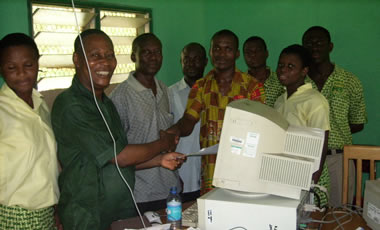
But there is yet another component of this company that does even more to combat pollution in Ghana. There is an increasing plastic waste problem that exists in the country. Almost everything that is sold in Ghana is vended in plastic bags, including water. Water is sold on city streets in plastic packets instead of bottles. These plastic packets and black plastic bags used to hold everything have been accumulating on trash dumps and on the streets since they aren’t biodegradable. Currently, there is no national waste management system in the country. The bags also clog the drainage systems causing floods during the heavy rain season. For this reason, an ‘Eco-Code’ has been drafted by CARE to be signed by all students of schools that receive computers donations. This code requires them to put measures in place to curb this pollution.
I look forward to seeing how CARE will change the face of pollution and recycling in Africa and the e-waste menace.
Labels:
E-waste,
Ghana,
recycling,
technology gap
Tuesday, April 27, 2010
Digital Dumping: the latest environmental crime
Ever wondered what happened to your old televisions, radios, computer monitors and systems when you threw them away and upgraded? I’m sure some of you might have donated them to charity, others might have ‘recycled’ them with electronic companies, and then some of you just threw them in the dumpster (admit it). Well, I have news for you. They all end up in the same place regardless of how you got rid of it.
It is becoming big business to ship outmoded electrical overseas to poorer countries instead of recycling them with environmentally safe methods. Some of these countries have no idea that they are getting ‘trash.’ They are told that they are ‘donations’ only to find out that half of them don’t even work. The non-functional goods are then dumped on sites that have turned into mountains. This sort of pollution would never be entertained in America. But America is causing it elsewhere. And as these heaps of e-waste grow, the poor begin to scavenge through the rubble is search of anything valuable. Boys and women, even children have created an occupation out of searching through e-waste trash heaps for valuable copper wire and other spare parts that could be sold for money. In order to be able to extract these wires and parts, they burn the plastics coverings of the monitors and tvs to expedite the process. The fumes emitted are toxic and are a slow poisoning to these ignorant victims of the irresponsibility shown by the developed world.
The video below, presented by Frontline on PBS, gives detailed coverage of the process, first visiting the Korle Lagoon in Ghana and then tracking a container of supposedly recycled e-waste all the way to Hong Kong. The Korle Lagoon was once a wetland that helped maintain the natural balance of the environment in and around Ghana’s capital, Accra. Now it has been named one of the most polluted water bodies in the world. Even the locals call it Sodom and Gomorrah: a dumping site for the trash that the West has conveniently forgotten about.
The fight against the dumping of e-waste is a global campaign that is finally beginning to attract the attention of the necessary decision-makers of developed countries. With all the conversation around the world about climate change and environmental preservation, hazards like this are no longer able to fly under the radar. I will bring more developments on the steps that NGO’s and governments are taking to clean up the mess that has been made.
E-WASTE: Re-Focusing of my blog
For the remainder of the semester we have been asked to refocus our blogs on one particular topic. Something that we believe has not been covered in class or something we would like to talk about that has to do with technology. I have decided that I will focus the remainder of my blogging on E-waste. This is a term given to the remains of electronics such as old televisions, radios and computers. At the moment, there exists no legislation in the United States to regulate how these items are discarded of. The EPA has made rules of its own that keep the US in check. But what about the rest of the world? I will focus my upcoming posts uncovering the situation not really here in the US but worldwide.
Subscribe to:
Posts (Atom)


